
No products in the cart.

Ubtan Ritual in Indian Households: When Even Rama Was Offered Ubtan
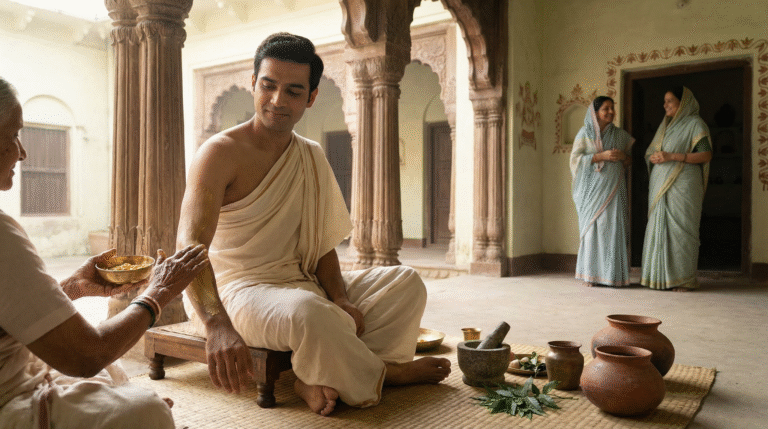
Ubtan ritual in Indian households during the ancient times is reflected through moments in folk songs that are not just poetry — they are living footnotes of civilization.
There is a line in a Maithili folk song that feels playful on the surface, but profound when you pause and listen closely:
“Ae pahuna, ehi Mithiley mein rahuna…”
O guest, stay here in Mithila.
The song is sung during the wedding of Rama and Sita. It is light-hearted, teasing, affectionate. And then comes the line that surprises many modern listeners:
Rama will be made to stay for a month — and ubtan will be applied to him daily.
Yes.
Ubtan. On Rama. Not once. Not as a bridegroom ritual. But as a daily practice.
That single line quietly tells us something modern skincare forgot.
What the Folk Song Tells Us About the Ubtan Ritual in Indian Households
This Mithila song does not treat ubtan as a cosmetic luxury.
It treats it as routine care — so normal that even a guest, even a groom, even a man is expected to follow it.
No embarrassment.
No gender divide.
No “special occasion” label.
The ubtan ritual in Indian households was part of daily living, not vanity.
Skin was not “decorated.”
Skin was maintained, strengthened, protected.
Ubtan Was Not About Fairness — It Was About Readiness
In the song, Sita’s friends jokingly say that Rama is dark and they will make him fair by applying ubtan.
But folk humour works through exaggeration.
The deeper truth lies elsewhere.
Ubtan was applied because:
- Travel tired the body
- Dust and sun stressed the skin
- Marriage was a sacred transition
- The body needed grounding and nourishment
Ubtan prepared the body — not the mirror.
That is why the ubtan ritual in Indian households was not optional.
Why Men and Women Both Followed the Ubtan Ritual
Our ancestors never divided care into:
- “beauty for women”
- “strength for men”
Skin was considered a living organ, deeply connected to:
- blood circulation
- muscle tone
- heat balance
- sensory perception
Ubtan kept the skin:
- warm without overheating
- clean without stripping
- firm without dryness
That is why Rama receiving ubtan feels normal in the song — because it was normal.
How the Ubtan Ritual Slowly Disappeared from Indian Homes
The ubtan ritual in Indian households did not vanish suddenly.
It faded quietly.
- Bathrooms replaced courtyards
- Quick showers replaced slow care
- Pump bottles replaced freshly mixed pastes
- “Instant glow” replaced long-term health
Ubtan began to feel:
- messy
- time-consuming
- old-fashioned
And gradually, it was pushed into weddings, haldi ceremonies, and nostalgia.
What We Lost When Ubtan Became an “Occasion Ritual”
When ubtan left daily life, we lost more than a skincare step.
We lost:
- a few silent minutes with our own body
- the habit of touching skin with awareness
- the rhythm of seasonal care
- the connection between health and beauty
The ubtan ritual in Indian households was never only about skin.
It was about slowing down before stepping into the world.
Why the Ubtan Ritual Matters Even More Today
Today, skin is exposed to:
- pollution
- artificial fragrances
- over-cleansing
- chemical layering
Ironically, we apply more products but touch our skin less mindfully.
Ubtan works in the opposite direction:
- fewer ingredients
- intentional preparation
- physical involvement
- sensory awareness
It is not fast.
And that is exactly why it works.
Reviving the Ubtan Ritual in Indian Households — Gently, Not Rigidly
Revival does not mean returning to the past blindly.
It means:
- choosing ubtan once or twice a week
- preparing it fresh, not storing it for months
- applying it slowly, without mirrors
- allowing skin to respond naturally
Men. Women. Elderly. Young.
Ubtan does not discriminate — tradition never intended it to.
A Folk Song as a Reminder, Not a Rulebook
The beauty of the Mithila song lies in its casual tone.
It does not preach.
It jokes.
It invites.
Just like it invited Rama to stay.
The ubtan ritual in Indian households was never forced.
It was lived.
And perhaps that is how it should return —
quietly, gently, lovingly —
from weddings back into mornings.
A Folk Song as a Reminder, Not a Rulebook
The beauty of the Mithila song lies in its casual tone.
It does not preach.
It jokes.
It invites.
Just like it invited Rama to stay.
The ubtan ritual in Indian households was never forced.
It was lived.
And perhaps that is how it should return —
quietly, gently, lovingly —
from weddings back into mornings.
Closing Thought
If ubtan was worthy of daily application for Rama in a folk song,
it is worthy of a place in our homes —
not as nostalgia,
but as care.
A Quiet Continuation, Not a Revival
Some traditions don’t need loud revival.
They need gentle continuation.
In a world rushing toward synthetic shortcuts, there is quiet value in brands and households that choose to remember before reinventing.
That philosophy — of preserving rituals without spectacle — is what quietly shapes Rajwada Secrets.
Not as a trend, not as nostalgia, but as an extension of practices that once lived naturally in homes, courtyards, and songs like Ae Pahuna Ehi Mithiley Mein Rahuna.
Because some wisdom was never meant to disappear.
Only to wait — patiently — until we were ready to return to it.
No comment yet, add your voice below!