
No products in the cart.

Ayurvedic Skincare Rituals: The Quiet Beauty That Once Made King Dushyant Pause
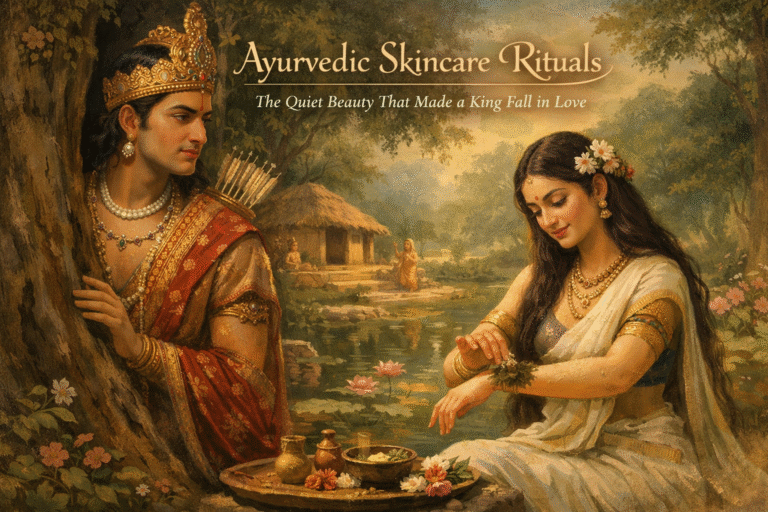
Ayurvedic skincare rituals were never created to impress mirrors or promise instant results. They were born from a quieter understanding—that skin reflects the rhythm of life itself. Long before beauty became a routine, it was a state of balance, nurtured through oils, herbs, touch, and time. In ancient India, skincare unfolded gently within daily living, shaped by seasons, surroundings, and inner harmony.
It was this kind of living beauty—unforced, grounded, and luminous—that once made a king, Raja Dushyan, pause in a forest hermitage, noticing not adornment, but radiance.
When Raja Dushyant entered the ashram during a hunting expedition, he did not expect to be transformed by a moment. Yet something made him pause. It was not jewellery, not adornment, not anything deliberately. It was a presence—quiet, grounded, and luminous in a way that could not be manufactured.
That presence belonged to Shakuntala.
Kalidasa does not describe her as dressed for admiration. He describes her as radiant by nature. Her beauty did not announce itself. It rested effortlessly—shaped by the forest, nourished by routine, and softened by ritual.
That glow was not coincidence.
It was cultivation.
Ayurvedic Skincare Ritual: Beauty, Before It Was Named
In ancient India, skincare was never about fixing something that was broken. There was no urgency to correct, conceal, or compete. Skin was understood as a living surface—responsive to food, sleep, seasons, emotions, and touch.
Ayurveda saw twacha as an expression of inner balance. When digestion was steady, when daily rhythms were respected, when the mind was calm, the skin reflected it naturally. Beauty was not a goal. It was a by-product of harmony.
This is why Shakuntala’s radiance stayed with Raja Dushyant. He did not witness beauty as display. He experienced beauty as alignment.
Ayurvedic Skincare Ritual Was a Way of Living Then
Life in a hermitage was simple, but never careless. Simplicity allowed attentiveness. Care was unhurried, intentional, and woven into daily life rather than separated from it.
Ayurvedic skincare rituals unfolded quietly:
- A gentle application of oil after bathing
- Herbal pastes prepared fresh, never stored
- Cleansing with water infused with roots or petals
- Slow facial massage, guided by touch rather than instruction
- Natural protection from sun and wind using plants
These were not steps to follow.
They were gestures of respect.
Ayurvedic skincare rituals did not demand time. They asked for awareness.
Ayurvedic Skin Care Rituals: Why Oils Were Chosen with Care
Today, oils are often treated as indulgence or inconvenience. In Ayurveda, oils were nourishment—carefully chosen, patiently prepared, and thoughtfully applied.
Cold-pressed oils, infused slowly with herbs, were selected according to season and constitution. Used correctly, they supported the skin quietly:
- Maintaining softness and resilience
- Protecting against dryness and fatigue
- Supporting circulation and tissue comfort
- Calming imbalances caused by climate or lifestyle
What mattered was not abundance, but appropriateness. The right oil restored balance without announcing its work.
This sensitivity to individuality sits at the heart of Ayurvedic skincare rituals.
From Forest Silence to Palace Courtyards
As kingdoms flourished, these rituals did not disappear. They travelled—intact—from forest hermitages into palace courtyards and private chambers.
In royal households, care remained rooted in the same principles. Ubtans were still prepared fresh. Oils were still cooked slowly. Massage was still unhurried. Skin was still cared for according to season and temperament.
Luxury was not excess.
Luxury was precision and patience.
Thus, Ayurvedic skincare rituals became an unbroken thread—linking simplicity with refinement, nature with royalty.
The Forgotten Power of Touch
One of the most overlooked aspects of modern skincare is touch.
Ayurveda understood that how something is applied matters as much as what is applied. The rhythm of movement, the direction of strokes, the gentleness of pressure—all were considered part of healing.
Facial massage was not indulgence. It was daily nourishment. A moment where skin, breath, and attention met.
Perhaps this is why such beauty felt alive. It was sustained not only by herbs and oils, but by presence.
Why Modern Skincare Often Feels Unsatisfying
Despite abundance, modern skincare often leaves people restless. Shelves are full, yet skin feels unsettled. This is because much of today’s skincare treats skin as a surface to manage, rather than a system to understand.
Ayurvedic skincare rituals ask quieter questions:
- How is your digestion reflecting on your skin today?
- How has the season changed your needs?
- How is stress appearing on your face?
- What does your skin need now, not forever?
These questions turn skincare into a relationship, not a routine.
Why Rajwada Secrets Returns to Ritual
Rajwada Secrets does not recreate the past for nostalgia. It returns to ritual because ritual still works.
By honouring cold-pressed oils, minimal ingredients, fresh preparation, and mindful application, the brand restores an approach where skin is nourished patiently, not pushed hurriedly.
Beauty that lasts has never been rushed.
Why Ritual Always Outlives Product
Products can change. Rituals endure.
Ayurvedic skincare rituals remain relevant because they:
- Respect the body’s intelligence
- Encourage consistency over novelty
- Nourish rather than overwhelm
- Align beauty with wellbeing
This is the quiet confidence that once made a king pause—and it is the same confidence that still feels deeply reassuring today.
True beauty does not demand attention.
It simply invites it.
No comment yet, add your voice below!