
No products in the cart.

Why Oils Were Infused Slowly, Not Scented
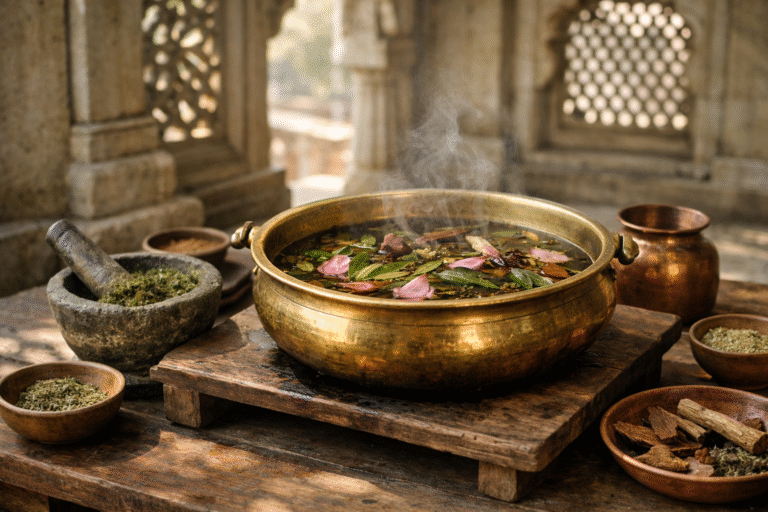
The Ayurvedic oil infusion wisdom behind Rajwada beauty rituals.
Introduction: When Fragrance Was Never the Goal
In today’s beauty world, oils are judged first by how they smell.
Rose. Jasmine. Lavender. Sandalwood.
But in traditional Indian households—especially in Rajwadas—fragrance was never the purpose of oil.
Instead, oils were prepared through Ayurvedic oil infusion, a slow, deliberate process where time, temperature, and herbal synergy mattered more than sensory appeal.
This raises a fundamental question:
Why were oils infused slowly, not scented, in traditional beauty rituals?
The answer lies in Ayurveda’s understanding of skin, absorption, and long-term nourishment—an understanding modern cosmetic culture often overlooks.
Ayurvedic Oil Infusion – What it means?
Ayurvedic oil infusion is the process of transferring the therapeutic properties of herbs into a natural oil base through controlled heat and time.
Traditionally, this involved:
- Selecting a suitable base oil (sesame, coconut, almond)
- Preparing herbs as pastes or decoctions
- Heating the oil gently until all moisture evaporated
- Allowing phytochemicals to bind with the oil
This was not perfuming.
This was medicine preparation for daily life.
The resulting oil carried nourishment deep into tissues rather than sitting superficially on the skin or hair.
Infused Oil vs Scented Oil: A Fundamental Difference
One of the most misunderstood aspects of traditional beauty is the difference between infused oils and scented oils.
Infused oils:
- Carry lipid-soluble herbal compounds
- Are stable and suitable for regular use
- Work gradually and deeply
Scented oils:
- Rely on added fragrance or essential oils
- Offer immediate sensory gratification
- Often prioritise aroma over function
In Ayurvedic traditions, healing was never rushed, which is why infused oils were preferred over scented ones.
Why Scent Was Never Central in Rajwada Rituals
In Rajwada households, beauty rituals followed Ayurvedic discipline, not trends.
A strong fragrance was not considered proof of quality. In fact, overly aromatic oils were often avoided because they could:
- Overstimulate the senses
- Aggravate sensitive skin
- Mask poor oil quality
Ayurveda teaches that what we apply externally should support internal balance. Loud fragrances disrupt this balance, especially for Pitta-prone or sensitive skin.
That is why traditional oils smelled:
- Earthy
- Herbal
- Mildly medicinal
They were meant to heal quietly, not announce themselves.
Ayurvedic Understanding: Skin Is a Living Organ
Ayurveda never treated skin as a cosmetic surface.
Skin is:
- A functional organ
- A site of absorption
- Closely linked to circulation and metabolism
Anything applied to the skin was expected to support:
- Tissue nourishment
- Dosha balance
- Long-term resilience
Ayurvedic oil infusion allowed oils to penetrate gently without irritation, making them suitable for daily rituals like abhyanga, hair oiling, and body care.
The Science of Slow Infusion
Slow infusion is not nostalgia—it is functional science.
Gentle heat and time allow:
- Fat-soluble compounds to integrate fully
- Oils to become stable and long-lasting
- Moisture to evaporate completely, preventing spoilage
This is why traditional oils could be stored safely and used consistently without preservatives.
In Rajwada rituals, time itself was an ingredient.
Why Modern Scented Oils Feel Good but Don’t Last
Modern scented oils often feel luxurious at first application.
But many fail to deliver lasting nourishment.
Why?
Because they prioritise:
- Immediate aroma
- Quick manufacturing
- Market appeal
Rather than:
- Absorption
- Tissue support
- Long-term skin health
Traditional infused oils were used less frequently—but their effects were deeper and more enduring.
Essential Oils vs Ayurvedic Oil Infusion
Another modern confusion is equating essential oils with infused oils.
They are not the same.
Essential oils:
- Are highly concentrated
- Volatile and potent
- Best used sparingly
Ayurvedic oil infusion:
- Is gentle and nourishing
- Designed for daily rituals
- Safer for prolonged use
In traditional beauty care, essential oils were rare. Infused oils formed the foundation of everyday self-care.
Why Ayurvedic Oil Infusion Matters Today
Modern skin faces challenges unknown to earlier generations:
- Pollution
- Chronic stress
- Hormonal imbalance
- Over-cleansing
What it needs is not more stimulation—but restorative nourishment.
Ayurvedic oil infusion provides:
- Barrier support
- Improved absorption
- Compatibility with seasonal and circadian rhythms
It works slowly, but it works deeply.
Rajwada Wisdom: Beauty Followed Discipline
In Rajwadas, beauty was not chased.
It was cultivated.
Oils were:
- Prepared seasonally
- Used patiently
- Passed down through observation
This discipline is what preserved skin and hair health across generations.
Why Rajwada Secrets Chooses Infusion Over Scent
Rajwada Secrets follows a simple principle:
If it was not trusted by generations of women, it does not belong here.
That is why:
- Oils are infused, not perfumed
- Fragrance is never forced
- Ritual matters more than reaction
This is not minimalism.
This is Ayurvedic integrity.
Conclusion: When Oil Was Medicine, Not Merchandise
The practice of Ayurvedic oil infusion reminds us that care does not need to be loud.
True nourishment:
- Works quietly
- Respects the body
- Reveals results over time
The women of Rajwadas understood this wisdom.
Rajwada Secrets simply chose to listen.
No comment yet, add your voice below!